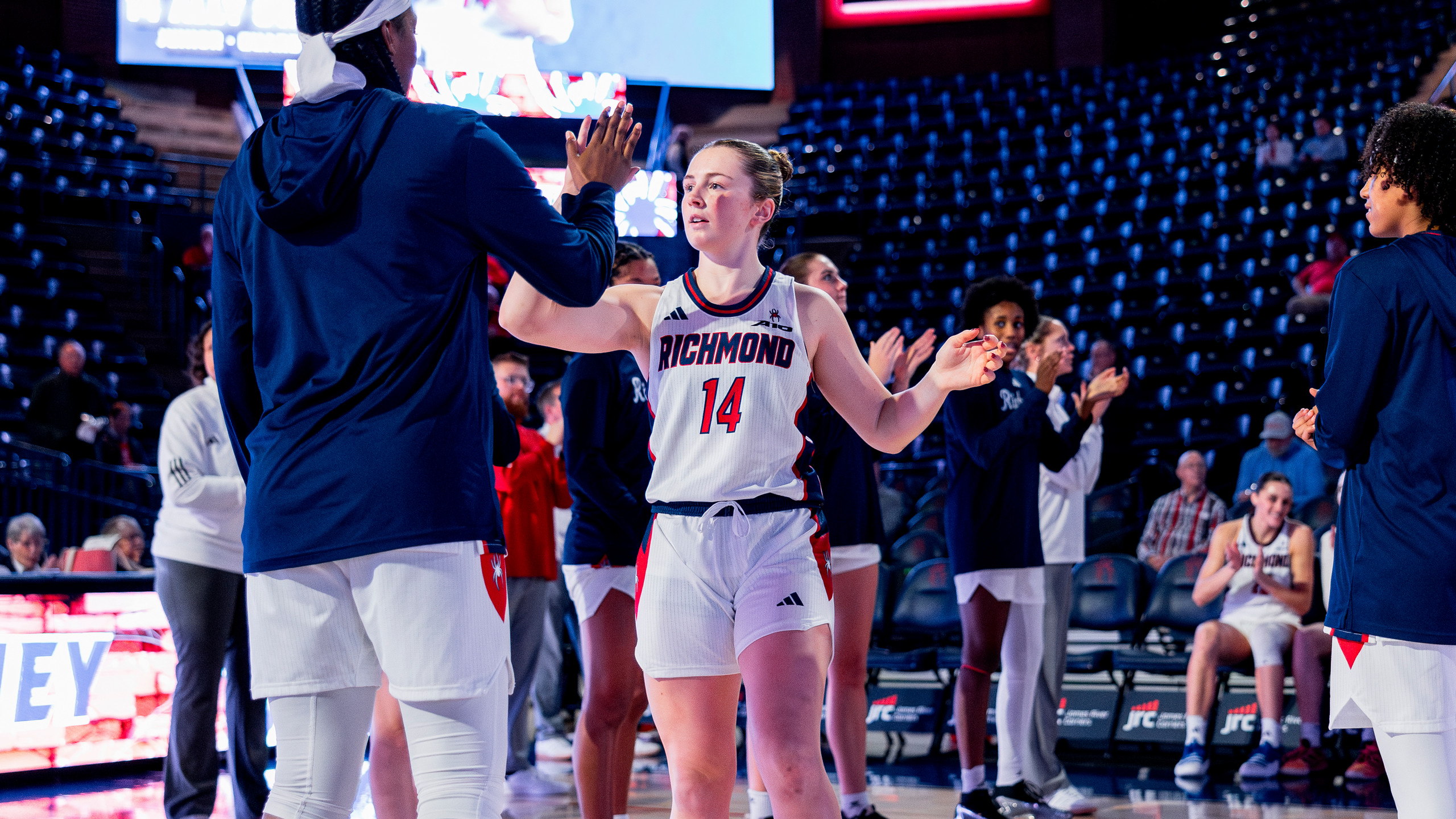
ON SATURDAY, Spider forward Maggie Doogan dropped 48 points during a triple-overtime thriller over the Davidson Wildcats. Doogan’s point total was a Richmond and Atlantic 10 record and the highest single-game point total in D-I women’s basketball so far this season. When Doogan woke up the next morning, she was the No. 1 scorer among all D-I women’s basketball players so far this season, with 436 points. (After games that day, she’d fall back to No. 2; current stats here.)
The contributors to the performance she’s having this season are vast: Her natural physical gifts. Her hours in the gym, the weight room, and film study. Her incredibly talented, hard-working teammates who earn defenses’ attentions then get her the ball at the right moments.
Perhaps that list should include an oft-overlooked intangible: She’s the daughter of a coach. Her mom, Chrissie, had a stellar playing career at La Salle and became a D-I coach before becoming Maggie’s high school coach. Together, they won a state championship Maggie’s senior year. (Read more about them in “The Making of Richmond Spider Maggie Doogan.”)
“I remember at the end of my senior year, my state championship, we had just won, and she was emptying the bench, and I was crying on the court and just kind of walked into her arms,” Maggie Doogan (below) says. She says a lot of her game today has to do with her mom. “The way I prepare, watch a lot of film — I got that from her.”
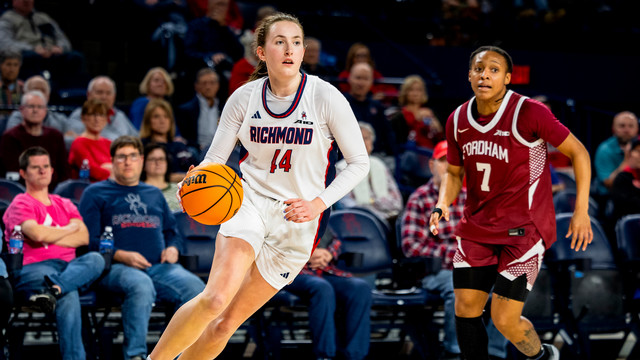
“The smarter player has an advantage at every level of basketball. When you’ve grown up around it, you get better.”
A parent-child relationship like the Doogans have can bring incredible intangibles to a player’s game, says Spider head coach Aaron Roussell.
“When you’re a coach’s kid, you have no choice but to watch a lot of basketball,” he says. “I think what you get with that is the IQ part of the game. ... When you’re looking at Ally, Maggie, and Rayne, those guys definitely have that. They’ve grown up around basketball, so they understand the nuances of it.”
“Ally, Maggie, and Rayne” are the coaches’ kids on the current squad. Junior Ally Sweeney (top image) is the team’s starting point guard. Rayne Wright, also a guard, is getting the second-most minutes among freshmen this season. Both played key roles during the triple OT win against Davidson. Sweeney never subbed out, playing every one of the game’s 55 minutes (another Richmond record) and scoring 18. Wright suffocated Davidson’s Charlise Dunn, an A-10 All-Conference player the last two seasons, during crucial defensive stretches over her 30 minutes in the game.
Roussell says their background as coaches’ kids gives them a leg up for understanding a “feel for the game” that can be hard to measure during recruiting.
“You have to be able to read cuts and other things — that’s the non-black-and-white part of the game,” he says. “There’s a lot of gray with basketball. A lot of people, when you start playing basketball, it’s ‘Coach, tell me what I need to do, and I’ll do it.’ We can do that to a certain extent, but there are certain aspects that are played in the gray, and that’s why the smarter player has an advantage at every level of basketball. When you’ve grown up around it, you get better.”
That doesn’t mean that growing up in it is always easy or always feels good. Sweeney’s father Shannon, who played professionally in Europe after his college ball at Rutgers-Newark, coached her travel team until she reached high school. Mom Jennifer played the role of mediator, encouraging them to compartmentalize the basketball part of their relationship, “but that never really worked out for us,” Sweeney says. “I wish I could say that it was just him bringing it up, but it was me too. Like, it’s impossible to keep basketball separate. So once we figured out that dynamic, it was good for us.”
Still, there were nights after games when she made it a point to ride home with her mom after she and her dad had gotten into it during a game.
“If he didn’t like how I had done, I knew I was going to hear about it, and I just didn’t want to deal with it,” she said. “Sometimes I was like, ‘It’s so annoying. Why is he harder on me than everyone else?’ But then also he pushed me as much as he possibly could, and that really helped me in the long run.”
The line between parent and coach that Shannon Sweeney walked can be difficult. Rasheed Wright, father of Rayne Wright (below), knows it, too. After a great college career playing for Old Dominion, he played professionally in France for 13 seasons. That gave his daughter Rayne the opportunity to grow up around the professional game. (Fun fact: Spider Tony Dobbins, ’03, was a teammate of Wright’s in France and sometimes babysat young Rayne.) Today, Rasheed Wright is head coach at Manchester High School just south of Richmond, where Rayne played. Like the Doogans, the Wrights won a state championship together, and Rayne was named Richmond’s 2025 All-Metro player of the year.
Rasheed Wright says that growing up with a coach as a parent means players like his daughter are getting lessons continually.
“They’re around their parents outside of practice and hear their parents talking about the game,” he says. “If your parent is a coach, you’re hearing the nuances of the game. You’re hearing strategy. It’s almost like if your parent is a doctor, and you’re around medical stuff all the time. You’re going to be able to say things that the average person doesn’t know but you understand because you’re around it all the time.”
Still, it can make for a complicated dynamic within the family.

“Now I’m happy to be dad who’s coming to games to support her and give her advice if she wants it.”
“Coaching [Rayne] is one of the hardest things I’ve ever had to do from a basketball standpoint,” Rasheed Wright says. “The day after the last game I coached her, me and her were like, ‘Huh, okay, okay.’” He mimics a huge sigh of relief. “‘Now I can just go back to being dad, and you can go back to just being daughter.’ ... Now I’m happy to be dad who’s coming to games to support her and give her advice if she wants it, but I’m so happy I’m not her coach anymore.”
Rayne Wright feels the same way. Sometimes, she says, “You just want Dad, and you don’t want to be talking basketball all the time.” On balance, though, she says that growing up the kid of a coach has been a huge advantage for her game.
“It creates a sense of comfort because they know you best,” she says. “They know what they’re talking about, and they know how to put you in the best situations. Even though it might not feel great in the moment, it works out.”
That depth of experience shows up in the conversations between coaches and players, Roussell says. Players these days generally want to know the why behind decisions more than in the past, he says, and that’s even more true of coaches’ kids. But, he emphasizes, they still have a lot to learn, too, when they reach the college-level game. “The conversations I have with Maggie right now are way different than what we had [when she was] a freshman,” he says. He puts Sweeney in that category and expects Wright to get there, too.
He also makes one last point about coaches’ kids generally and Doogan in particular. Being a coach’s kid is great background, but it’s just groundwork. “I think Maggie takes it to the ultimate because she watches so much basketball,” he says. “Ally’s in the same boat. Ally watches a ton of basketball, and you can watch it with a coach’s eye. I tell young assistant coaches and even players, if you really want to understand basketball, don’t watch the ball. It’s a learned trait to be able to watch 10 players and know what all 10 players are doing. When you’ve grown up around the game, it’s a little bit easier to get to that.”