Forum
Modeling constructive dialogue
The University of Richmond is recognized as a place that values and supports the exchange of ideas.

Leading up to last fall’s Virginia gubernatorial election, students from UR’s College Democrats and College Republicans organizations debated for the first time in four years. The teams presented thoughtful arguments. They listened to one another. Many others listened too. More than 200 UR students filled every chair, stood along the walls, and peered down from the banisters of Tyler Haynes Commons — in rapt attention. One student moderated. Another student kept time. It was precisely the kind of event that should happen at a university like ours.
As I said in my very first message to our university community, nearly five years ago, “Universities can and must serve as models of constructive dialogue, especially across differences. … Not everyone here agrees on everything — and that is good — but everyone cares and wants to make Richmond even better. I believe the best way to do so is to make it better together.”
This is why, in 2023, I became an early member of College Presidents for Civic Preparedness. This group, now more than 100 college leaders strong, is dedicated to improving campus dialogue and equipping students with the essential skills for effective citizenship.
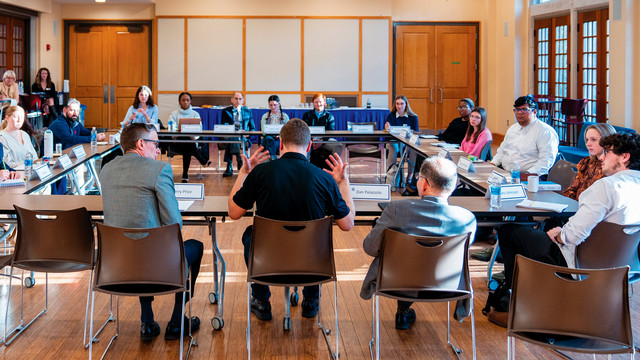
We are already doing a lot to foster these skills at Richmond. We offer focused discussions, multi-faith dialogues, topic-based reading groups, and a dedicated student fellows program. Professors can receive support for navigating challenging classroom conversations through our Faculty Hub. Our new general education curriculum, the Web of Inquiry, is designed to prepare students to contribute, engage, and adapt in a complex and interconnected world.
“[Students] have a great deal to gain from considering a wide range of ideas and giving one another the benefit of the doubt.”
We also invite visiting speakers to campus to help Spiders explore timely topics from diverse perspectives. Over the past two years, guests have spoken about the value and meaning of marriage, masculinity, religion, leadership, and risk, as well as the future of artificial intelligence and what democracies and universities stand to gain from embracing a shared commitment to free expression. A guest speaker in the university’s McDowell Institute Lecture Series recently said that the institute’s “willingness to entertain a range of thinkers and ideas from across the political spectrum makes it a unique place in American higher ed.” I agree that that kind of openness is less common than it should be. I’m proud Richmond is being recognized as a place that truly welcomes and supports the exchange of ideas. I also believe this is an area where we should strive to do even better.
Students come to our campus with so much to share and learn from one another. They have a great deal to gain from considering a wide range of ideas and giving one another the benefit of the doubt. When Spiders graduate, they should be equipped to absorb new information, approach complex issues with balance, and consider multiple sides of an argument. These skills will serve them at work, at the dinner table, and throughout their lives — and they are essential for lives of purpose, thoughtful inquiry, and responsible leadership.