Arts
He graduated with an art degree. That wasn’t his original plan.
“I went to UR with the expectation of being a physicist,” says artist and teacher Jeff Hall, ’94. “And boy, that is not how it turned out.”
Hall grew up fascinated by both physics and art, so when he struggled through a course called Mathematical Methods in Physics, he pivoted to his other love. He switched his major to studio art, dramatically got down on his knees during registration at the Robins Center, and begged professor Mark Rhodes to let him enroll in his introductory sculpture class.
“He said, ‘Are you really on your knees begging for a spot in this class? You’re in,’” Hall recalls.
But Hall’s affinity for the sciences nudged him toward a second ask of Rhodes. Could he also take on a summer research project turning computer-generated 3D shapes into sculptures made of bronze and stone?
Rhodes said yes.
At graduation, the art major considered the job market. Although Hall had “zero interest” in teaching, he did have student loans. Following a suggestion from his mother, he entered the teaching profession with the goal of staying just long enough to pay off his debts, no more.
Three decades later, Hall is still teaching — and loving it. He’s even found a way to blend his artistic and technical proclivities. As an art teacher for the Henrico (Virginia) County Public Schools in the late ’90s and early 2000s, Hall developed the visual arts program for a new Center for the Arts and launched a one-to-one laptop system to bring Apple iBooks into the classroom. Apple co-founder Steve Jobs even delivered the keynote speech at the induction ceremony. To teach instructors and administrators to use this new technology and the then-nascent Internet, Hall established a class that introduced PowerPoint decks and led virtual field trips using Google Earth.
“Now it’s commonplace,” Hall says. “At the time, it was revolutionary.”
Hall never stopped making his own art. Atop his responsibilities as a teacher and parent, Hall earned a master’s degree in interdisciplinary studies from Virginia Commonwealth University. The program’s painting and drawing classes — and the deadlines they imposed — helped him keep creating. Hall also recently completed a residence at the Visual Arts Center of Richmond exploring printmaking techniques.
“I went to UR with the expectation of being a physicist. And boy, that is not how it turned out.”
In 2007, Hall became chair of the fine arts department at the Maggie L. Walker Governor’s School for Government and International Studies in Richmond. The school’s commitment to global studies allowed him to broaden his students’ artistic horizons and his own. In addition to leading art-oriented school trips to France, Greece, and Italy, Hall twice won the school’s Taylor Teaching Award for International Travel. His most recent win, in 2026, will take him to South Africa to introduce him and his students to the region’s art and culture.
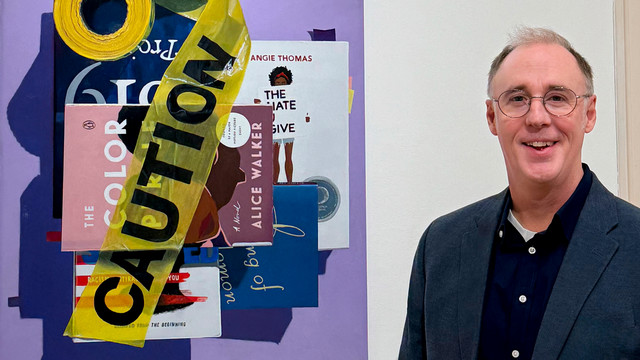
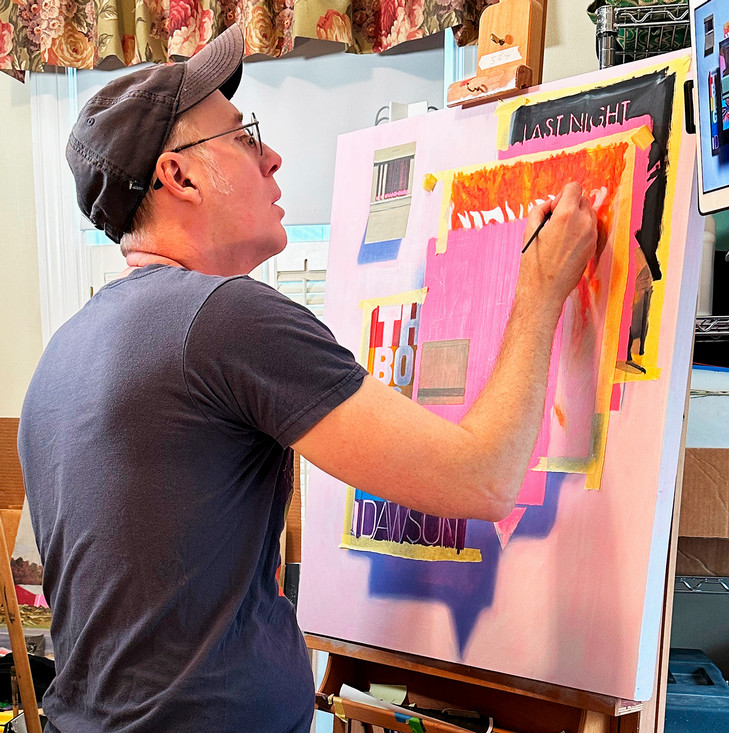
Hall’s art spans an array of media, including sculpture, digital, and hyperrealistic trompe l’oeil paintings — a technique that creates optical illusions on two-dimensional surfaces. He credits Richard Waller, Richmond’s former executive director of University Museums, with persuading him to experiment with the latter. His results are so lifelike that gallery visitors often mistake them for photographs.
It’s not the career he’d imagined, but Hall couldn’t be happier with it. “Besides my wife and kids, it turned out to be one of the best things in my life,” he says, pointing to the meaningful relationships he’s built with his students and his own continuous growth as an artist.
Thanks to his time — and one notable academic turn — at Richmond, Hall learned “the ability to be open to new ideas and continuous learning.” It’s a quality he advises students to cultivate as well: “Be open to the path not being what you think it’s going to be.”