Business
Have you played padel yet?
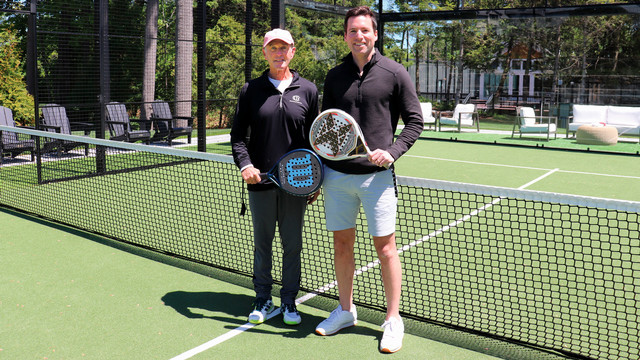
When Bill Ridenour, R’79, retired after 40 years in magazine publishing — working for TIME, Sports Illustrated, Fortune, and Golf Digest — he wasn’t looking for a leisurely life on the sidelines. Instead, he found himself in a new game entirely: the emerging racket sport padel.
The opportunity came through Gray Bigler, ’08, who pitched Ridenour a business idea at a UR alumni event. Bigler was earlier to the sport than most, picking it up in 2014 while living in Sydney, where he attained a national ranking. After spending more than a decade working in financial technology and management consulting, Bigler had grown restless with traditional corporate life. He yearned to get back into padel. His family connections — including his brother’s work with MejorSet, a top Spanish court manufacturer — gave him that chance, and he took it.
Together, they founded OTL (Outside the Lines) Court & Design, a consultative company that handles every aspect of padel court development: permitting, architectural design, and installation. “We wanted to be a one-stop shop, not just slingers of courts,” Bigler said. “Plus, most of the other manufacturers don’t go out and visit everyone in person. That’s something I appreciate about the approach of [OTL Court & Design]. It is very much a relationship-driven industry right now, and that’s how we’re winning deals and building momentum.”
The Spider connections don’t end with Ridenour and Bigler. “Brian Stark, ’08, is an old fraternity brother of mine from Sigma Phi Epsilon,” Bigler said. “He’s super plugged in to the Midwest’s country club scene and has made several introductions for us.” Ridenour’s Phi Delta Theta fraternity brothers have also played a role by “introducing us to many clubs in the Northeast.”
“It is very much a relationship-driven industry right now, and that’s how we’re winning deals and building momentum.”
While padel remains relatively unknown to casual sports fans in the United States, the numbers tell a compelling story. Globally, up to 35 million people play padel, and the sport has grown from 20,000 courts worldwide in 2018 to more than 50,000 today. The U.S. court count has increased sixfold since 2020, with facilities that once focused on pickleball pivoting toward padel.
What makes padel unique? Imagine tennis and squash merged: Play occurs primarily in doubles on an enclosed court with inbounds glass walls, an underhand serve that reduces double faults, and turf that’s gentler on joints. “The stat is something like 92% of first-time players come back and play again,” Bigler said. “It’s that sticky a sport, which is amazing.”
As Ridenour put it, “I haven’t had one person that has played the game that doesn’t walk off and say, ‘I love it.’”