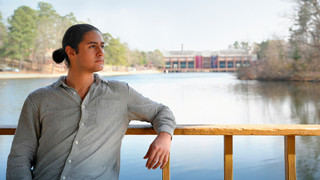
In his two decades of life, Ibrahim Alkaseer, ’26, has felt a shifting sense of home.
For the last four years, home has been the University of Richmond, where he graduated with degrees in political science and economics in May. This fall, it will be the University of Oxford in the United Kingdom, where he’s set to pursue graduate school after receiving the prestigious Rhodes Scholarship.
There was also a high school on the hilltops of rural India where he met students from all over the world.
And before that, Damascus, Syria — the place where he was born and where his parents still live. The home he hasn’t visited in six years and perhaps won’t for many more to come, but where he still feels deeply rooted.
As Alkaseer has moved through these corners of the world, he has witnessed civil war and economic turmoil, but also incredible privilege and possibility. It’s given him a distinct perspective on migration, politics, economics, and the ties that bind them.
But perhaps most of all, his life experiences have driven him to seek an understanding of home — what it means to leave it behind and how complicated the question of one day going back can be.
Life amidst an uprising
Alkaseer’s early childhood resembles the lives of countless working-class families.
He was born in Al-Tadamon, a neighborhood on the outskirts of Damascus. His father worked as a civil servant, his mother a middle school English teacher. Both were the children of farmers from the rural city of Salamiyah.
“It was very diverse,” he says. “We had almost every component of Syrian society. We had Iraqis and Palestinians, Shia and Sunni Muslims, Christians. We all shared the same lived reality. We all lived in urban precarity and inequality.”
In 2011, everything changed.
That January, Arab Spring protests spread across several countries, reflecting discontent with authoritarian leaders and the high cost of living. In Syria, protestors challenged the government led by Bashar al-Assad, which responded with force. Opposition militias formed to fight back, and by the following year, the country was engulfed in civil war.
Alkaseer says the uprisings were tied to the country’s economic conditions. Before the war, unemployment was high, and farmers were unable to sell their crops. The war escalated the conditions, and Alkaseer felt the impact directly when both of his parents lost their jobs.
Alkaseer was 9 when he was first displaced, and his family was again displaced several more times in the years that followed. But they never left Syria, even as his aunts, uncles, and cousins scattered across Europe. Staying in place was safer, they felt, than crossing uncertain waters.
Life for Alkaseer and his family continued — until again, everything changed.
In 2019, he joined a state-sponsored debate team. For the first time, he engaged with social science issues and ethical concepts, considering them from a broader perspective than the one he lived day to day. The team also offered an avenue to new experiences, including travel outside of Syria to participate in international competitions.
After one “life-changing” trip to Thailand, he began applying to international high schools. Alkaseer was accepted to United World Colleges and spent two years at UWC Mahindra College in Pune, India.
“It was the first time that my material conditions radically changed,” he says. “And it’s also when I connected with other people who had a similar lived reality in terms of caste violence, displacement, and urban precarity.”
As a UWC graduate, Alkaseer was eligible for the Davis UWC Scholarship program, which provides scholarship support for students who attend partner universities in the U.S. — including the University of Richmond.
A curious mind
Alkaseer has never been one to focus on a single discipline. Rather, he’s always looking for the connections and nuances that tie ideas together.
At Richmond, he paired majors in political science and economics with a minor in Latin American, Latino, and Iberian studies that allowed him to study Spanish and Portuguese.
He also layered in courses from other areas, always looking for a new or surprising angle he hadn’t yet considered. For instance, after using satellite imagery to explore how the Syrian landscape had changed throughout the war, he signed up for an advanced geographic information system (GIS) class to better understand spatial analysis methods.
In every class, he brings depth and nuance and doesn’t shy away from difficult subjects.
David Giancaspro, associate professor of Spanish, recalls how Alkaseer would often stay after class for philosophical discussions, using language skills that went far beyond the intermediate level expected of him. Once, he even brought in a complex political text, written in Spanish, that he had been working through on his own.
Giancaspro says a conversation between Alkaseer and a language partner from Chile captures both his drive and his empathy. The 30-minute one-on-one meetings are intended to help students practice their language skills. The topics are predetermined, the conversations often surface-level.
Alkaseer, however, came to one meeting with a list of detailed questions about Chilean politics.
“He ... helped build a classroom environment where everyone felt that they could participate. ... He has a way of spurring conversation.”
“After a few minutes, it became clear that Ibrahim’s conversation partner had very different political perspectives,” Giancaspro says. “Once Ibrahim realized this, though, he began gently interrogating his partner in order to understand the nature of these beliefs.
“I remember listening to this conversation after it happened and marveling at Ibrahim’s Spanish, as well as his political knowledge and ability to manage tough conversations.”
Jennifer Pribble, professor of political science and global studies, first met Alkaseer in her Latin American politics class in fall 2024 and says he stood out right away.
“He had already read and thought about some of the foundational texts,” she says. “He could be critical of them and bring a different position, sometimes questioning the authors in interesting ways or interrogating the evidence. But he also helped build a classroom environment where everyone felt that they could participate. He didn’t intimidate other students. He has a way of spurring conversation.”
Alkaseer didn’t just study the issues; he actively engaged with them. As a Bonner Scholar, he worked with the Virginia Interfaith Center for Public Policy, supporting its advocacy for criminal justice reforms and raising the minimum wage. He also volunteered with nonprofits that support refugees and immigrants who resettle in the city.
Through his Spanish in the Community class with Karina Vázquez, senior teaching faculty of Latin American, Latino, and Iberian studies, he tutored Spanish-speaking students and talked to them about preparing for graduation and college.
“I was mapping the nonprofit scene, the advocacy scene, justice in general,” he says, “and how we can approach it as a community.”
He also saw volunteering as a way to stay connected to the daily lives of his friends and family back home and in the diaspora. Both in the classroom and out in the city, Alkaseer was drawing connections between the world he grew up in and the one in which he now lived — and discovering new questions he wanted to answer.
Connecting the threads
Once Alkaseer began applying a broader perspective to his own experiences living through political turmoil, he wanted to keep widening the lens.
He started by turning to the deeply entrenched Palestinian communities in Honduras and Chile. Both make up nearly 3% of the population — nearly a half-million people each. Members span generations and feel strong ties to their homeland, even among those who have never seen it firsthand.
The community in Chile, however, is far more connected and organized than the one in Honduras. They engage in protests and try to influence foreign policy, but they also have robust community centers and a professional soccer team.
So far, his work has focused on existing research, but he hopes to interview leaders in the Chilean Palestinian community about their experiences and efforts to lobby the government.
“The question is: Why is it so different?” he says. “Why do you identify with a homeland that you’ve never been to? Is it host country conditions? Class demographics? A horizontal solidarity of some sort?
“It’s hard to quantify. It dives into the larger picture of diaspora activism and social contracts.”
Pribble was an adviser on Alkaseer’s research and says his view of diasporas and their influence on foreign policy represents a new way of thinking about politics, rights, and constituencies.
“Ibrahim’s research focuses on the agency and voice of communities that are sometimes considered powerless and marginalized,” Pribble says. “He is pointing us toward the fact that these diasporas really matter to the places where they end up. He’s arguing that displaced people have power, and they can shape policy in the new places where they land in interesting ways.”
Last fall, Alkaseer turned his focus closer to home when he joined a research project led by Sandra Joireman, Weinstein Chair of Global Studies and professor of political science, and Kyle Redican, teaching faculty of geography, environment, and sustainability and director of the Spatial Analysis Lab.
Joireman specializes in post-conflict return migration and was monitoring the surge in Syrian returns after the overthrow of Assad in late 2024. About 6 million Syrians sought refuge abroad during the war, and millions more were displaced internally. Some are choosing to return, and Joireman wants to know why, what conditions they find upon arrival, and whether their return will last.
“We have people scattered everywhere; some want to return, and some don’t,” Alkaseer says. “I wanted to ask more of an empirical question about whether that has an effect on my own country. We ended in a rebel victory, and the dictatorship fell, but what effect does that have on governance and economic conditions? There are a lot of factors still inhibiting our development. The brain drain — when people pursue education abroad and don’t come back — is a big problem. And we don’t have the infrastructure for everyone to come back.
“I was displaced in Syria, and my whole family is in diaspora, so these are important questions: Do you return? How pressured are you to return? What do you do when you return? Do you leave again? Are you better or worse off than when you were in the diaspora?”
More recently, Alkaseer shifted his focus from the political and social to the economic. For his senior thesis, he examined the economic determinants of revolution and popular uprisings, with a focus on the Arab Spring protests he lived through.
“What do you do when you return? Do you leave again? Are you better or worse off than when you were in the diaspora?”
“Most of the literature points toward political reasons [for the protests],” he says. “I would argue it’s mainly structural, as well as political. There was high unemployment, especially youth unemployment, which I think is a big driver. This is growth without development.”
Alkaseer sees his research across disciplines as pulling on threads that might one day untangle the links between migration, conflict, development, and capitalism. For instance, he says, studies of forced migration often focus on conflict. But when someone leaves their home in the Philippines to be a domestic worker in Qatar, is the choice any less forced?
“It sounds voluntary,” he says. “But at the end of the day, what are the conditions surrounding that choice? I want to interrogate the economic structures that push people to leave their children at home and work abroad in an unequal labor contract. It’s not conflict, but it functions in a similar way.”
The middle space
With graduation behind him, Alkaseer is now preparing for his next big move — this time to Oxford, England.
He received a highly competitive Rhodes Scholarship, which fully funds postgraduate study at the University of Oxford. He plans to earn a master’s in development studies. Alkaseer is the university’s sixth Rhodes Scholar and the first since 2006.
“It feels like grad school with a purpose,” he says. “I’ll be able to connect my continuously forming opinions and perspectives about the world with my research and my intellectual trajectory.”
Pribble says his voice is a necessary one.
“He’s interested in empirical research — the world as it is — but I think he’s motivated by a desire to see a more just and equitable world,” she says. “And he comes to that as someone from the Global South who has lived conflict displacement and who sees the world through that lens.
“That’s really powerful. We can learn about inequality theoretically, but someone who has experienced having less power sees those struggles differently and can bring new hypotheses and theoretical innovations.”
At Oxford, Alkaseer plans to continue his research on forced migration and the experiences of refugees. He wants to maintain the multidisciplinary perspective that he’s interwoven with people and places from his own life, even as each step he takes makes the possibility of returning home feel ever more remote.
“We cannot support higher education back home,” he says. “We don’t have a surplus of capital for our governments to support independent research. Our infrastructure is destroyed.”
It is in this middle space — where he moves seamlessly between the individual and the collective — that he hopes to uncover a fuller understanding of the root causes of forced migration in all its forms. And one day, he plans to share his ideas with others as a writer and educator.
“When you engage with the intellectual side [of these issues], it’s difficult to humanize them, even if you have a really good imagination,” he says. “If you’ve never met someone who’s been displaced, you might be able to form a picture from the news, but it’s not complete.
“I don’t consider myself a displaced person anymore. At the end of the day, I’m not hungry. I have access to everything I need. But I know the conditions I was once a part of, and I know what people back home are struggling with.
“I believe in our shared humanity, and I pay attention to the structures that estrange people from it.”