
After his job interview to become Richmond’s first varsity men’s lacrosse coach in the fall of 2012, Dan Chemotti sat in one of the upper parking lots near Robins Stadium. He wanted to think about the possibilities.
There was the school itself, its academic profile and size dovetailing well with other contenders in the sport. Geography was a major asset. A stadium was already in place. All it needed was the right people and time.
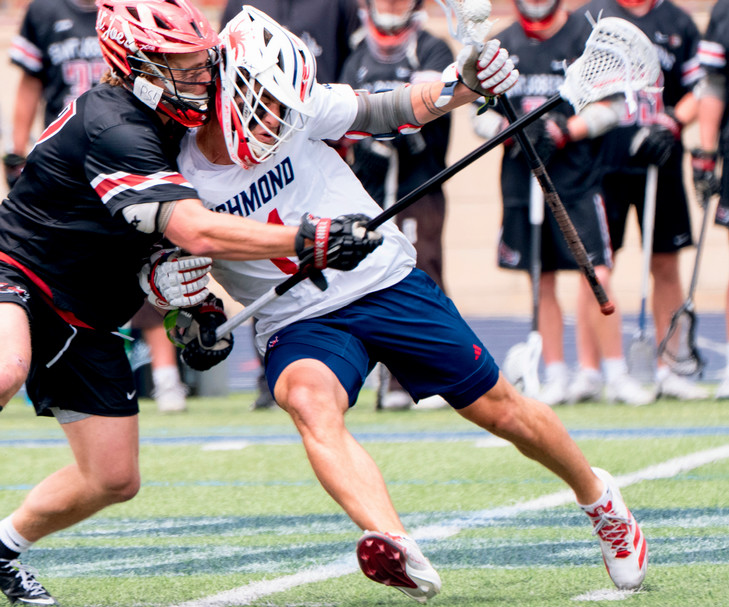
Chemotti would get the job and set about incrementally building a startup into a reputable national program. Fast-forward to today, and that has happened. Within the last 18 months, the Spiders have earned their first postseason victory, spent time ranked No. 1 in the country, and shattered the NCAA Tournament’s first-round attendance record when they played host to a game for the first time in May 2026.
As methodical and steady as Chemotti is, he admits to taking in the scene back in the spring, appreciating the broad sweep of what Richmond has accomplished in a relatively short amount of time.
“The decisions, the investment overall, the sweat equity you could call it,” Chemotti said. “It’s real. It’s very real. And the best part for me, this is what I thought it could be. This is what I envisioned.”
Chemotti is the first to say he hasn’t done it alone. With him the entire time has been defensive coordinator Paul Richards, who has been at Richmond since the summer before men’s lacrosse debuted at the school.
Together, they are the constants who have steered the Spiders into national prominence.
“It’s almost like we have two head coaches, because coach Chemotti has so much trust and faith in coach Richards to handle the defense,” senior long stick midfielder Brayden Penafeather-Stevenson said.
The thing is, they’re far from finished.

Richards’ own college experience at Loyola University Maryland in Baltimore didn’t get off to a promising start in 2005. The Greyhounds were, in his own telling, “really bad.” There was a head coaching change, and things improved his sophomore year. Then coach Charley Toomey hired Chemotti as an offensive coordinator. At the time, he was barely four years removed from playing at Duke.
Immediately, Richards took note of Chemotti’s attention to detail and his ability to coach the fundamentals. It was obvious to the young midfielder the Greyhounds would soon take a major step. Sure enough, they reached the NCAA Tournament during Richards’ final two seasons.
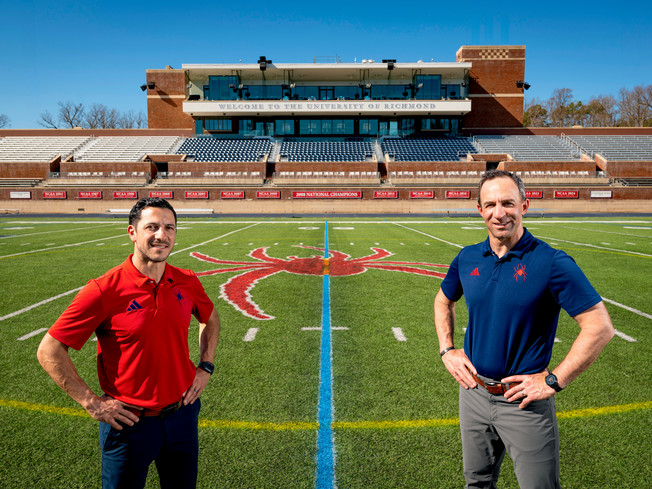
Richards, left, and Chemotti at Robins Stadium
“I mean this in the best way possible: It’s not all sunshine and rainbows. They get after each other, and they make each other better.”
Their paths remained intertwined through Richards’ stint with the Washington Bayhawks of Major League Lacrosse. He got into six games as a pro, where he was a two-way midfielder and a teammate of Chemotti.
“I still remember our practices and even in games, I’m communicating with him on the field, and I’m like ‘Coach, one more,’ and he’s like, ‘Stop calling me coach,’” Richards said. “That’s just the way I’m wired.”
Both would pursue coaching on separate tracks. Richards made one-year stops at Goucher College and Washington College in Maryland before jumping to Cornell University, a national power.
Meanwhile, Chemotti remained a pivotal part of Loyola’s renaissance, which culminated with a national title run in 2012. Less than four months later, Richmond revealed it would add men’s lacrosse. Chemotti, firmly established as one of the sport’s rising young coaches, was immediately intrigued.
“I knew enough about Richmond before lacrosse was announced here to know that if that school ever got lacrosse, they could be pretty good,” Chemotti said. “I was like, ‘This is the perfect fit. It has all the makings to be a great program.’ The question for me was always, ‘Why don’t they have a program?’”
When he took the position at Richmond, Chemotti had more than a year to get ready for the Spiders’ first game, but he couldn’t make any hires until the summer after he started. But there was interest in who would be part of his staff. Richards recalls asking about it at a fall recruiting event, only for Chemotti — in his typical, close-to-the-vest fashion — to merely say he was making a list of candidates.
So when Richards got a call from Chemotti shortly after the 2013 season, he figured it was primarily to congratulate him on Cornell’s Final Four appearance and to catch up. Instead, it was to ask him to come interview for a job.
In a way, Chemotti was setting a template for Richmond’s recruiting strategy moving forward. Identify like-minded people, build or expand a connection, and above all get them on campus.
“He was the leader in the clubhouse from the get-go,” Chemotti said.
It didn’t require much convincing for Richards to agree to come on at the ground floor of the program.
“As good of a coordinator as he was — obviously he won a national championship as a coordinator, so he was a pretty good coordinator — I always knew he was going to be an even better head coach,” Richards said. “So once my wife and I came down here and saw the place, the university and the surrounding area in Richmond, I don’t want to say it came as an easy decision, but it became a relatively easy decision.”
Chemotti and Richards are both from the Syracuse area, one of the sport’s traditional hotbeds. The contours of their formative lacrosse experiences were similar coming from a place where Mother Nature has some input on when the season actually begins.
While those central New York ties live on and they’ve worked alongside each other for 13 seasons, they are anything but identical.
“The fun part is our personalities are very different and complement each other well,” Richards said. “I trust my gut. I go with my instincts. I am high-energy and usually going to say what’s on my mind. Coach is very methodical, very analytical, very well thought out, and very thorough. We have the same principles, we have the same values, but we go about it in very different ways. I think they balance each other out.”
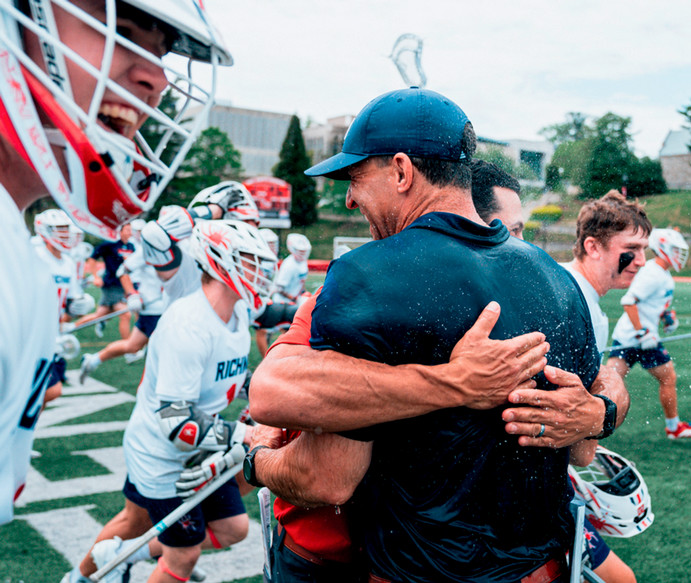
Chemotti, in ballcap, and Richard embrace after a win. Chemotti is the program’s first head coach. Over 13 seasons, he has led Richmond to a 132-69 overall record and seven NCAA Tournament appearances. In 2026, the team became the first in Richmond Athletics history to earn a No. 1 national ranking at the highest level of collegiate competition.
Chemotti directs much of his on-field energies toward the offense, with Richards afforded extensive autonomy at the other end of the field. It isn’t merely an internal thing; Chemotti will actively direct reporters seeking to write about the defense to talk to Richards.
It’s not a common trait, though it also reflects how little daylight exists between the two.
“It’s absolutely trust, and that trust was quickly earned, and it was earned before he was ever wearing a Richmond T-shirt,” Chemotti said. “The initiative that he takes, I would say that’s his superpower. You have somebody like that, that builds that kind of trust.”
While Richards might be the more aggressive of the two and Chemotti the more reflective, they’ve known each other long enough to recognize they have much in common. When they arrived at Richmond, they were handed no tradition, no history, no program alumni. There wasn’t a way things had always been done, which was both freeing and challenging. Every minute detail required a choice, a declaration of how things would be done.
Now? It’s just the Spiders’ blueprint crafted together, and Chemotti has ensured Richards has played a role in every decision made about the program.
“I think when you talk about discipline — doing things the right way, organizationally, attention to detail — I think that’s where we are very, very similar,” Richards said. “I think when you’re starting a program, the attention to detail was objective No. 1. I think our core principles are very, very aligned, and I don’t think we would have lasted as long as we have if that wasn’t the case.”
Particularly now, the staff’s long-standing unity is a selling point in recruiting. Stability and consistency hold considerable appeal, and Chemotti and Richards can promise those things because of their track record.
There’s also their mutual competitiveness, something seen just as easily on the practice field as it is on spring Saturdays.
“They definitely have a special relationship,” senior attackman Gavin Creo said. “I mean this in the best way possible: It’s not all sunshine and rainbows. They get after each other, and they make each other better. That definitely motivates us, and we see that. I feel like it just trickles down with the holding us accountable and pushing us to be better.”
The Spiders were a good story from the start. They reached the NCAA Tournament in their first season, and Richards said by the time their first recruiting class graduated in 2017, they got to thinking about whether Richmond could be a perennial top 10 program, even if convincing others was a bit more difficult.
The first-round NCAA Tournament victory at North Carolina (and the subsequent scare they gave eventual champion Cornell) in May 2025 heralded a feisty program with a penchant for knocking off high-profile opponents, and it was ready for more.
Nothing on or off the field in spring 2026 suggested otherwise. Richmond beat Virginia, Cornell, and Georgetown on the way to a 9-0 start and earned the top spot in the national polls. In the NCAA Tournament, the Spiders earned a No. 4 seed and then drew a program-record 6,805 attendees for a first-round postseason game against Duke.
The Spiders led in the fourth quarter before the Blue Devils surged to a 14-12 victory, spoiling the night. But Chemotti soon signed a long-term contract extension, and the school announced a $10 million lead gift from alumni Paul and Anne-Marie Queally to build a lacrosse-specific building with locker rooms, offices, meeting rooms, and strength and conditioning space at the north end of Robins Stadium.
“It’s really been everything we could imagine it to be, but the imagination is still greater,” Chemotti said. “We’re always going to keep chasing the highest level here.”
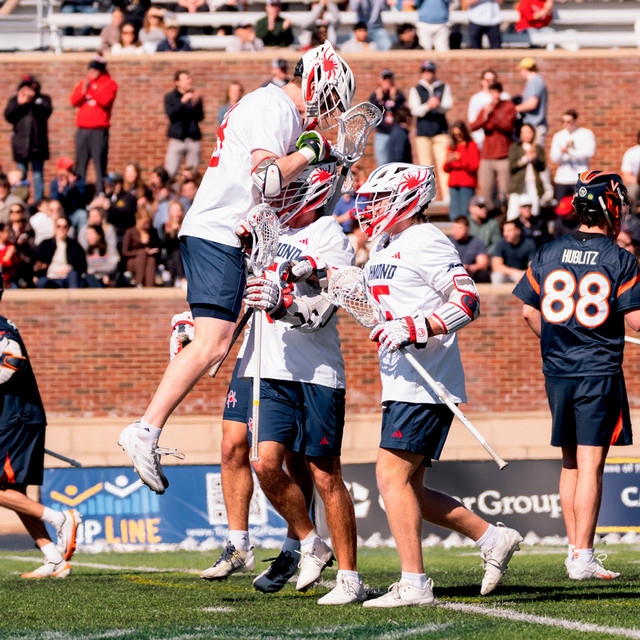
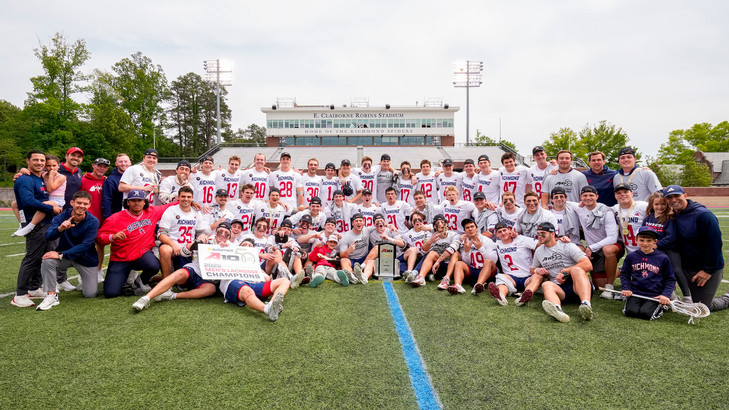
“It’s really been everything we could imagine it to be, but the imagination is still greater.”
Doing so means Richmond will try to break into a club with programs long accustomed to a lofty place in the sport. The likes of Cornell, Johns Hopkins, Maryland, North Carolina, Princeton, Syracuse, and Virginia all owned multiple national titles 30 years ago. Relative latecomers like Duke and Notre Dame are prominent national brands.
But the Spiders have a university and a local community behind them and in less than a decade and a half have established themselves as a signature team on campus.
“The amount of support between the Queallys and the school, they love us and [will say] ‘Hey, we understand where this program can go,’” Penafeather-Stevenson said. “You’ve seen it with that donation for the building.”
That investment — the new facility is scheduled to open in 2029 — is also a signal to recruits that Richmond is serious. So is the school’s successful bid to host one of the NCAA’s quarterfinal doubleheaders in 2028, a decision that will place an even greater spotlight on the program.
Those achievements were still deep into the future when Creo, a Long Island, New York, native, was choosing a school. But he was eager to be a part of Richmond’s growth and believes the last two seasons will go a long way toward drawing more talent to the school.
“You have to get down here because I came down here, and what I saw was exactly what coach Chemotti was building,” Creo said. “I saw the vision for this program. I came down here, and I had that belief already, and I saw that belief in all the guys in the team, and I really wanted to be a part of this program.”
Creo’s belief was never just in racking up NCAA Tournament appearances or 10-win seasons. There was always something greater in mind.
“I think the sky’s the limit,” Creo said. “That’s the cliché way of saying, ‘Yeah, we want to win a national championship.’”
It isn’t bravado. Richmond might be a relative newcomer to lacrosse, but it is moving fast. The program is commanding more attention than ever, and it ranked sixth nationally in average attendance in 2026.
Everything Chemotti viewed as an asset 14 years ago remains so. The school’s location makes it possible to create a challenging schedule, and it also holds appeal for recruits from northern areas who would like to avoid chilly winters. The Robins School of Business is a magnet for players in a sport well represented in the finance world.
Chemotti and Richards consistently find great recruits who are right for Richmond. And now, it seems, the Spiders are closer than ever to fulfilling their longtime coaches’ vision after the program’s best season to date.
“I think it’s a significant springboard,” Chemotti said. “It’s the springboard. Now is the time we have to capitalize because these moments, they are not guaranteed. They don’t come up every year or every other year. … I think everybody’s done an incredible job of saying, ‘This is awesome. We want to do this and want to make lacrosse something really special.’”
Patrick Stevens is a national sports reporter who frequently covers Division I lacrosse. His work has appeared in USA Lacrosse Magazine, The Washington Post, and other outlets.